
Case Study: MSU Tech Website
Date
Role

tech.msu.edu

The Challenge
The MSU Tech website presents significant usability challenges, including unclear labels and confusing navigation, which prevent students from efficiently completing essential tasks. These barriers frustrate users, slow down access to critical resources like enrollment support and cloud services, and reduce confidence in the platform’s reliability.
We then came up with the following research questions:
How might we redesign the MSU Tech website to reduce navigation confusion and make resources easier to find?
How might we ensure that labels and categories match students’ expectations so they can quickly locate enrollment help, cloud services, and other key tasks?
How might we improve the visibility and organization of essential actions to support smoother task completion?
Participants
7 MSU Students | Recruited through group mates | Daily technology users who use online coursework (e.g. D2L)

methodology: how we tested
Testing Approach: Remote usability testing through user interviews, 15–30 min sessions
Protocol: Think-aloud method; participants verbalize thoughts while navigating the site
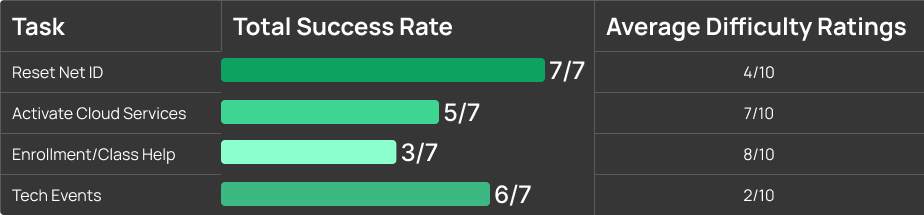
Data Collection: Tasks recorded for success/failure, difficulty ratings from 0-10(0 being not hard at all and 10 being impossible to complete), and critical incidents
Assigned Tasks:
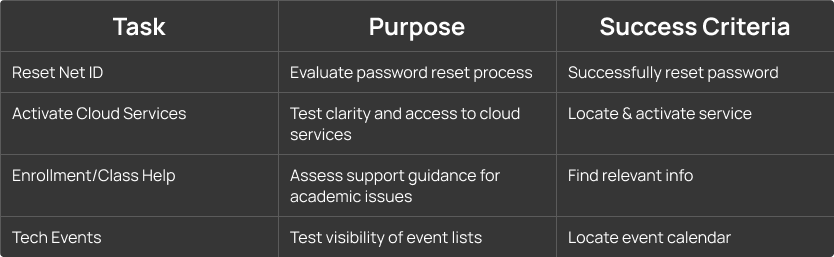
🔑Reset MSU NetID – Evaluate how easily users can find and follow steps to reset their password, which is a key requirement for accessing university systems.
☁️Activate Cloud Services – Test whether users can locate and set up cloud tools without confusion, especially around account linking.
📚Get Help with Enrollment Issues – Assess how well the site directs users to support when tech problems affect class registration.
📅Find Tech Events – Check the visibility and organization of event information for students who want to stay informed or get involved.
key findings
We found four major findings from this research:
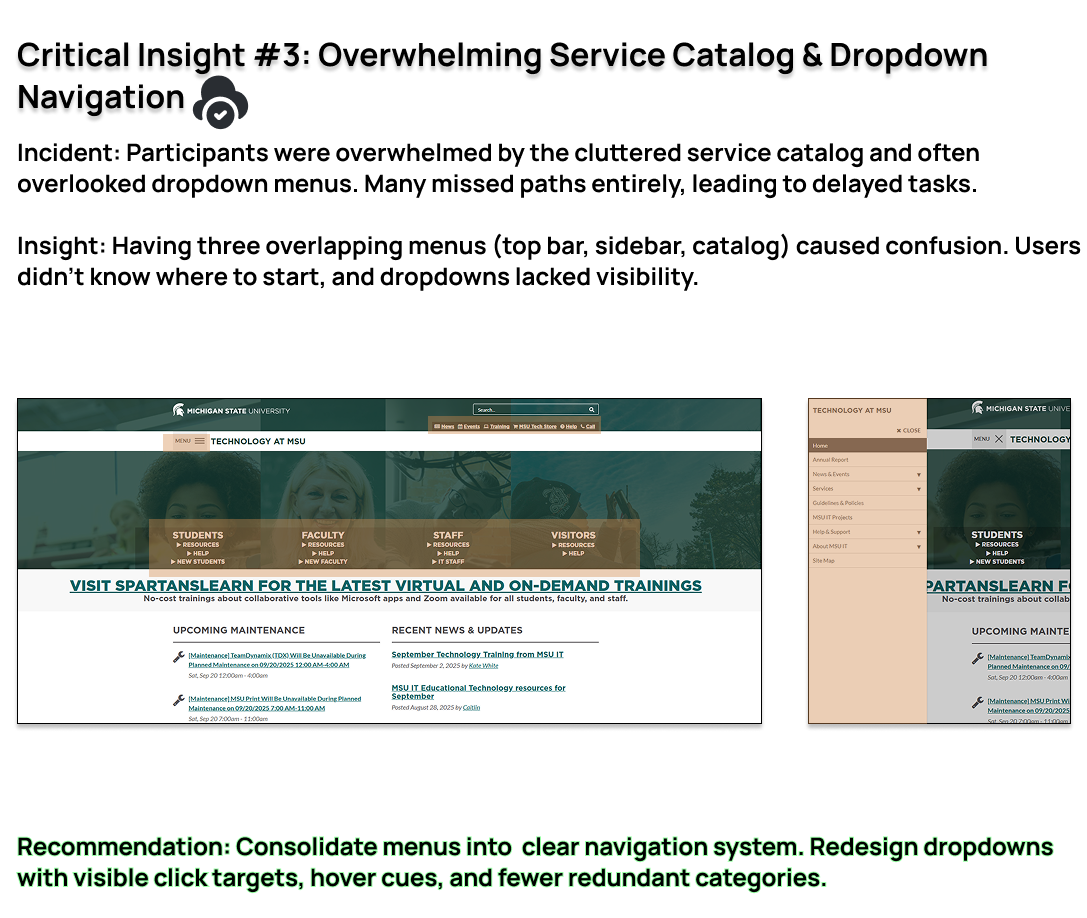
1. Navigation Issues: Users struggled with unclear paths, multiple menus, and inconsistent navigation patterns.
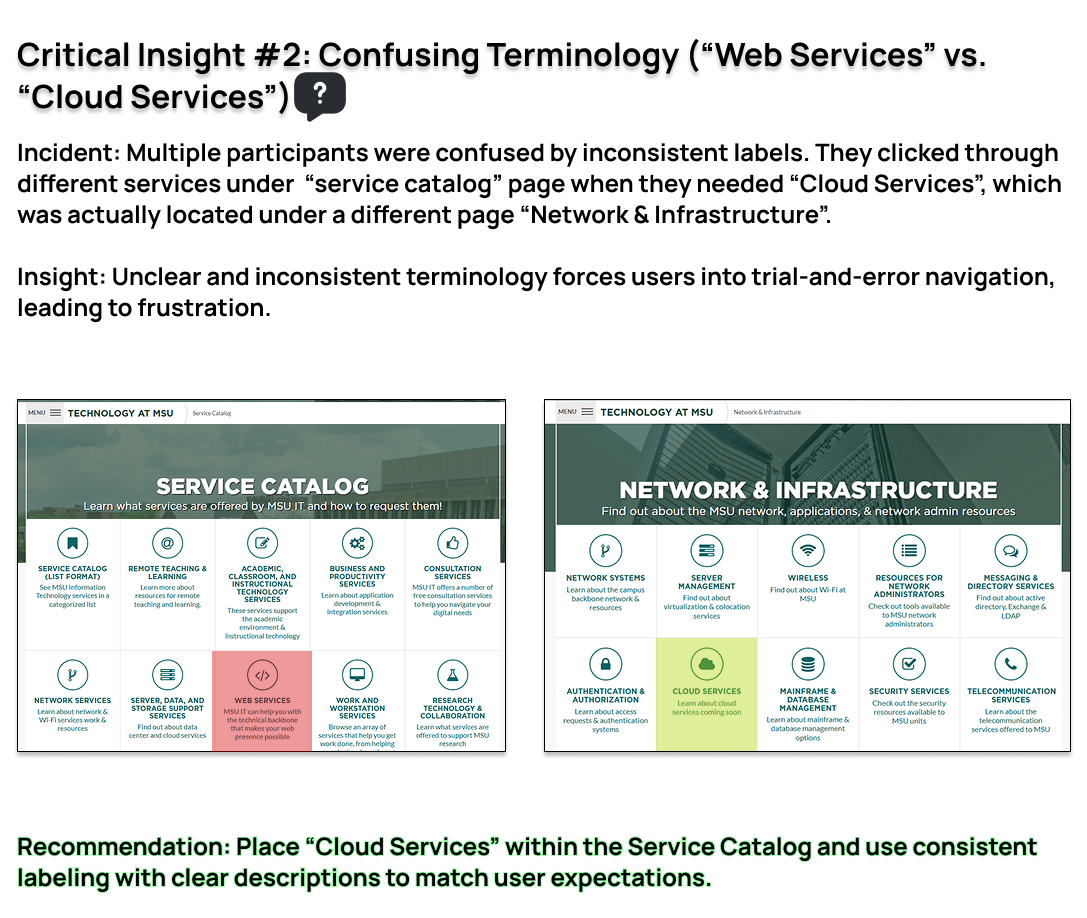
2. Confusing terminology: Users had no prior training or familiarity with the technical language used in the site, which affected their ability to identify the correct options.
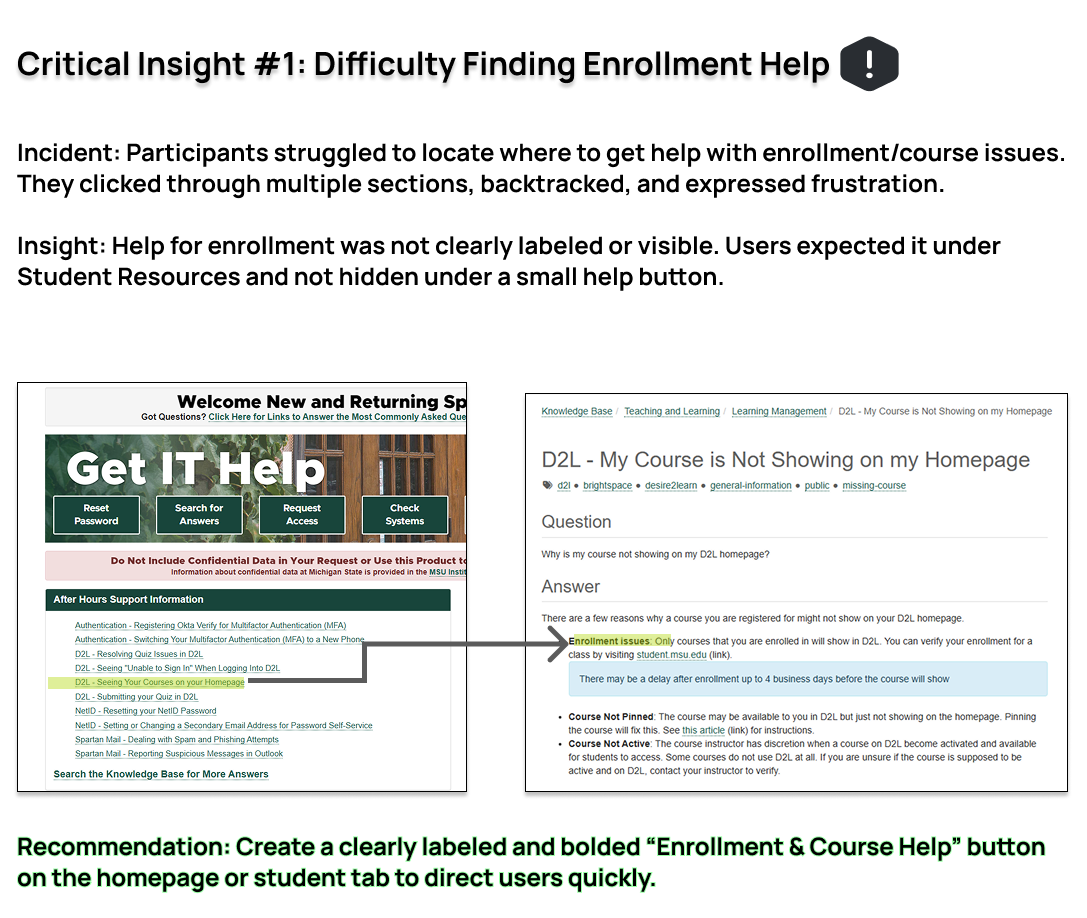
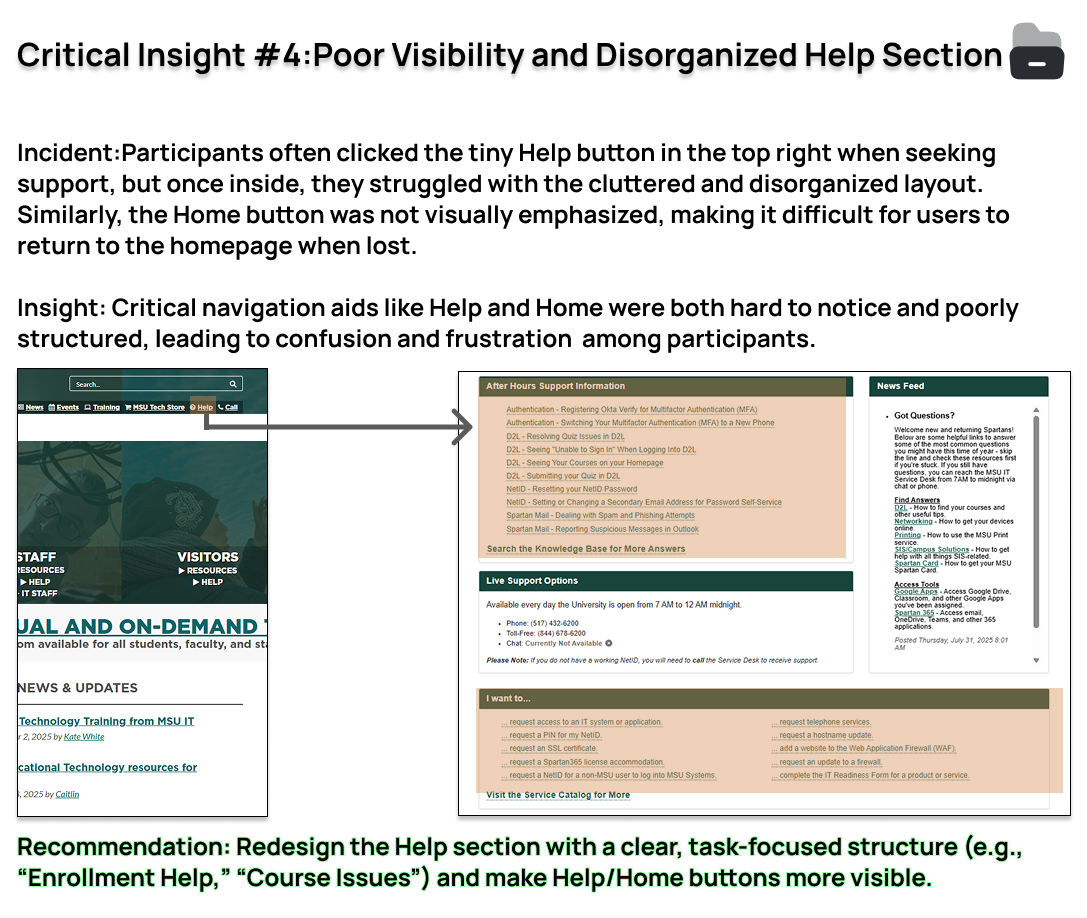
3. Low Visibility of Important Options: Help buttons and key actions were hard to locate.
4. Overwhelming Options: Service catalog had too many similarly labeled links, causing trial-and-error navigation.
critical incidents & insights
recommendations
🔑 Resetting MSU NetID Password
✅Add a prominent “Forgot/Reset Password” button on the homepage.
✅Streamline the reset process to reduce unnecessary navigation steps.
✅Reorganize service placement to align with user expectations (Cloud Service under Service catalogue page) and ensure consistent labeling.
✅Provide brief descriptions under each service to reduce confusion and misclicks.
✅Create a unified “Help” landing page that consolidates IT support and academic support in one place.
✅Clearly separate categories within the help page to guide students to the right resource faster.
✅Feature upcoming tech events with a spotlight section.
✅Sync the IT events calendar with MSU’s main events calendar for better visibility and consistency.
reflection
Through this project, I learned how to lead a UX research team with peers from diverse academic backgrounds while applying my psychology perspective to understand user needs. I strengthened my ability to empathize with users by placing myself in their shoes and focusing on clear communication. A key takeaway is the importance of designing at “eye level” with the target audience—students who are tech-savvy but still need intuitive pathways to complete essential tasks. In the future, I would experiment with different data collection methods to compare insights and dig deeper into the findings.